How far is the panel from your parking?
Longer cable runs, trenching and detached garages can add labor and materials. A shorter practical route may simplify the job.
 Get an estimate
HOME EV CHARGER INSTALLATION
Wake up ready to go. Find the right charging setup, understand the costs, and make your driveway work for your everyday life.
✓ Free planning tools ✓ No email to see your results
LAKE ZURICH · BARRINGTON · CRYSTAL LAKE
And nearby communities, roughly 10 miles around.
Know your numbers
Compare the cost of your routine.
Choose enough power
Match charging to your daily miles.
Install with a plan
Know what to ask before you commit.
YOUR HOME CHARGING PLANNER
Explore the numbers before making a decision.
Change any assumption to make the plan your own.
Vehicle profiles are illustrative, not model specifications.
Use the usable battery capacity and AC limit for your exact year and trim. The 90% efficiency is an editable modeling assumption. Driving efficiency here is battery-side; do not enter EPA wall-energy consumption as this number. Cold weather, conditioning and charging taper can change results.
Please correct the highlighted input. Results are paused until all inputs are within their shown limits.
Compare energy costs for the driving you would move to home charging.
Use the all-in energy rate on your bill. Rates shown are examples, not local price estimates.
ESTIMATED ANNUAL ENERGY SAVINGS
About $76 a month compared with paid public charging.
Energy-rate estimate for the same modeled wall-energy use. Public DC billing and losses can differ. Session fees are excluded.
See a typical daily top-up and a larger battery refill.
Output amps are not circuit breaker ratings. A qualified installer must determine the circuit and configure the charger. Choose the daily charge limit recommended by your vehicle maker.
TO REPLACE YOUR DAILY DRIVING
35 miles back in your battery.
Limited by the selected charger setting. Actual charging may take longer.
Start with the power you need. Then confirm your car, home and connection.
An open breaker space does not establish electrical capacity. A load calculation and site assessment are still needed.
A STARTING POINT TO DISCUSS
Enough modeled power to replace your daily miles within your overnight window.
This is a needs estimate, not an equipment approval. Your installer confirms capacity, circuit, connector and equipment suitability.
A local-market planning range for one hardwired Level 2 charger. No contact details needed to see it.
This is a regional benchmark, not a SenkusBuild quote. Your parking choice from step 3 is included. Complex work needs an individual assessment.
ESTIMATED INSTALLATION BUDGET
For the installation scope below, before charger hardware.
Capacity must be checked; any panel work is outside this range.
Installation benchmark covers typical labor, circuit materials and routine permit/inspection costs. Tax, trenching, repairs, load-management equipment and utility work are excluded. No rebates deducted. Final scope and price require a written quote.
Request my firm installation quote Prefer to talk? (312) 684-8469Published Chicagoland installer prices, checked October 20, 2026: MCL Electric lists $800–$2,000 for straightforward work. Egan Mechanical lists $900–$1,800 for attached-garage hardwiring, $1,500–$3,000 for difficult routes, and $2,500–$4,500 for a 200 A upgrade; charger hardware is separate. We model $900–$2,000 for a straightforward route and $1,500–$3,000 for a difficult one. These are advertised regional benchmarks, not verified completed-job averages or town-specific prices. Unknown routes span $900–$3,000. The panel allowance is added only when selected; excavation or shared parking has no reliable online upper limit.
Savings: daily miles × 365 × home charging share ÷ battery-side miles/kWh ÷ home charging efficiency = modeled annual wall energy. Multiply by each energy rate to compare costs. For gasoline, use those same miles ÷ mpg × price/gallon. Gas-to-EV savings describe a vehicle change; they are not savings created solely by a charger installation.
Speed: usable battery kWh × change in state of charge ÷ (the lowest of charger setting, available supply and vehicle AC limit × charging efficiency). Daily top-up uses your daily driving energy instead. We assume constant power; weather, taper, shared loads and conditioning can add time.
Setup: the lowest listed power that covers your daily driving within 80% of your overnight window, allowing a 20% time margin. This is a planning choice, not a code rule. An installer must verify the circuit and home capacity.
Payback: entered net installation and equipment cost ÷ positive annual modeled savings. The installation budget is not automatically used as a firm quote. Financing, maintenance, price changes and incentives are excluded. Level 2 is not automatically cheaper than Level 1 at the same electricity rate. Read the source guidance.
BEFORE THE FIRST PLUG-IN
The charger is one part of the job. Your home’s electrical capacity, parking spot and cable route shape the final installation.
Get your home assessment readyLonger cable runs, trenching and detached garages can add labor and materials. A shorter practical route may simplify the job.
An electrical assessment comes first. A panel upgrade is not always necessary; suitable load management may help share available power.
Discuss hardwiring or a suitable receptacle, indoor or outdoor equipment, connector compatibility and cable reach with the installer.
Ask about the charger, electrical work, permits, inspection, any trenching or repairs, setup and warranty. Confirm local requirements before work starts.
SMALL STEPS. FEWER SURPRISES.
Have these details ready for a more useful first conversation.
0 of 4 readyDo not remove the electrical panel cover. An electrician can inspect what is inside.
A LITTLE KNOW-HOW GOES A LONG WAY
Clear answers to the practical questions
behind home charging.
It depends on your electrical capacity, equipment, cable route, labor and local permit requirements. A standard nearby installation and a detached garage with trenching are different jobs. Get an itemized site-specific quote; use that amount in the planner to estimate simple payback. DOE installation guidance ↗
Not necessarily. An installer needs to check the existing service, household loads and charger demand. Compatible energy management may adjust charging to available capacity. A full-looking panel or an empty breaker space alone cannot answer the question. Example of manufacturer power management ↗
Level 1 may cover modest daily driving when you can stay plugged in long enough. Level 2 gives you faster replenishment and more flexibility. Use your daily miles and overnight window in the planner, then have the circuit and equipment checked. Never assume an existing outlet is suitable just because the plug fits. EPA charging guide ↗
Check the exact year, model, trim, AC inlet and maximum AC charging rate. J1772 and J3400/NACS are connector families you may encounter. Use only equipment and adapters approved for that vehicle and charging type; a DC fast-charging adapter does not automatically work with AC home charging. Example of adapter limitations ↗
It depends on the miles you charge at home, vehicle efficiency, charging losses and your electricity rate. The planner shows a monthly energy-cost estimate alongside the comparison. Off-peak tariffs can change the result; check your utility’s current rate structure, including any added plan fees.
Yes, suitable equipment can be installed outdoors. The installer must verify the equipment’s environmental rating, mounting, cable route and local requirements. A detached garage may need additional wiring or trenching. Follow the manufacturer’s instructions. DOE home charging guidance ↗
For rented or shared property, clarify parking rights, owner or association permission and electricity billing before buying equipment. For two EVs, discuss compatible shared-power equipment and both driving routines with the installer. The planner estimates one vehicle.
As checked October 20, 2026, ComEd’s 2026 residential EV charger rebate is closed to new applications. Future funding and eligibility may change. The federal Section 30C credit is not available for property placed in service after June 30, 2026. This planner does not subtract incentives. Check current terms before budgeting for any rebate. Check ComEd program status ↗Check current IRS guidance ↗
Do not use an extension cord as a workaround for a charging cable that cannot reach. Plan equipment placement and cable length around your actual parking spot. Follow the vehicle and equipment instructions and have new electrical work assessed by a qualified installer. For an installation contractor in Illinois, check ICC EV charging certification and local registration. Find Illinois certification guidance ↗
LOCAL HOMES. PRACTICAL PLANNING.
Planning an EV charger in Lake Zurich, Barrington or Crystal Lake? Start with your routine and your home, then confirm coverage for your address.
Target service area: roughly 10 miles around these communities. ZIP codes help start the conversation; final coverage and permit jurisdiction depend on the property.
Talk to SenkusBuild: (312) 684-8469 ↗Confirm the installing contractor’s ICC certification, municipal registration, permit requirements and inspection process. Mailing city and ZIP code do not always identify the permitting authority.
FROM “MAYBE” TO A CLEAR NEXT STEP
Bring your charging plan to an installer. A home assessment can confirm your electrical capacity, equipment and installation price.
Educational content checked October 20, 2026. This planning guide is not a site assessment. Equipment, permits and service availability must be verified for your location.
The planner does not submit entries to a form server or store your contact details in browser storage. Opening an email request passes the details you entered to your email app; you decide whether to send it. Downloads are created on your device. SenkusBuild’s website uses analytics and advertising tools, and hosting services may process connection logs. For these services and the separate contact form, see our privacy policy.
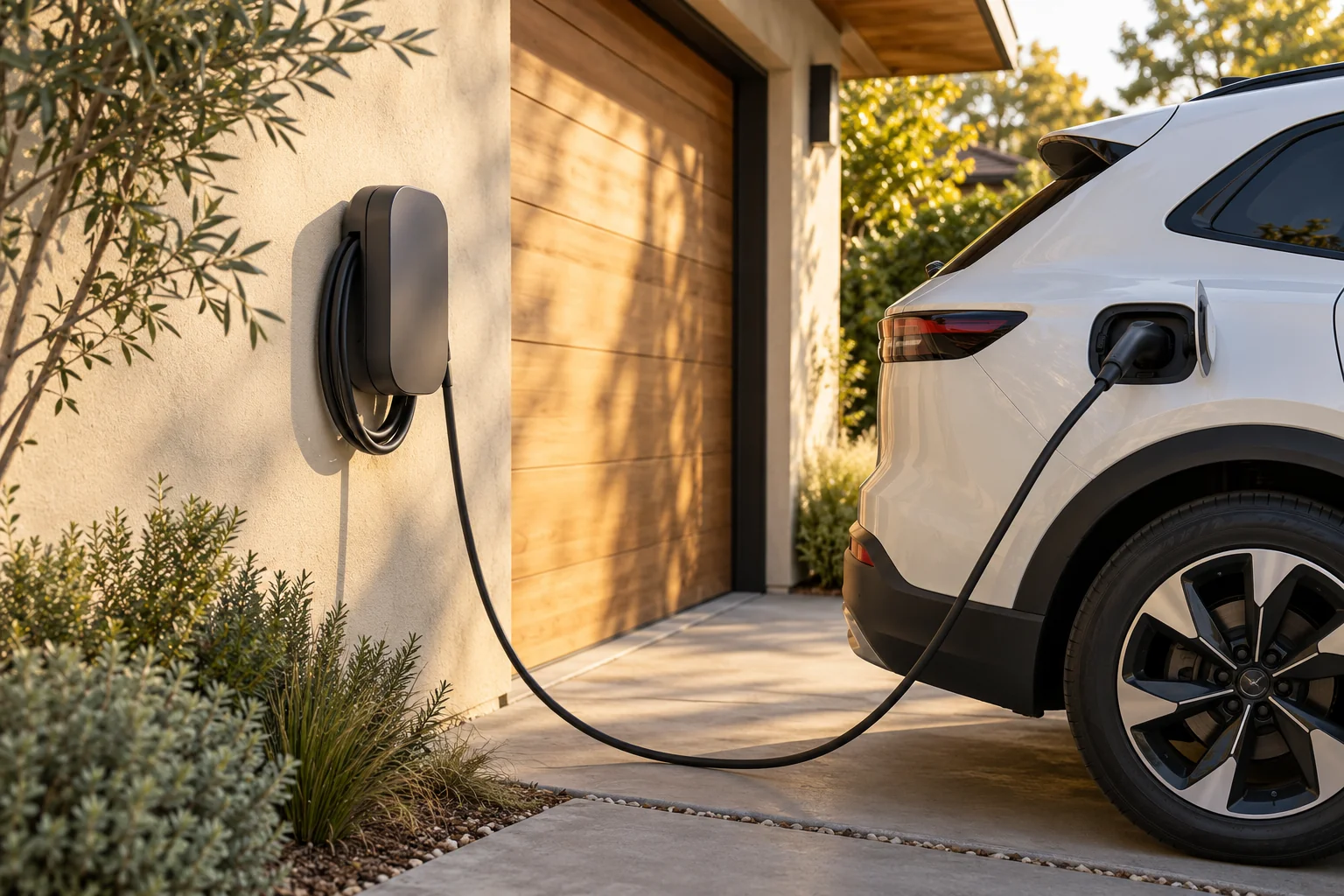
Prepared for SenkusBuild. The hero image is an AI-generated illustration, not a completed SenkusBuild project. Calculator results are estimates, not quotes. Installation credentials, equipment and scheduling must be confirmed before a project is accepted.