
Master Bath vs. Main Bathroom: Which Should You Remodel First?
Learn more
Lorem ipsum dolor sit amet, consectetur adipiscing elit. Vel ut congue varius congue aliquet leo. Netus neque nibh semper in diam viverra nibh aliquam elit. Amet orci et dolor, faucibus a leo malesuada ullamcorper. Amet pellentesque velit felis mollis turpis pellentesque donec. Cursus consectetur mattis molestie nibh no.
Lorem ipsum dolor sit amet, consectetur adipiscing elit, sed do eiusmod tempor incididunt ut labore et dolore magna aliqua. Tristique risus nec feugiat in fermentum posuere urna nec.

Lorem ipsum dolor sit amet, consectetur adipiscing elit. Morbi amet, lorem tristique feugiat ac lorem maecenas. At integer mauris, nunc tortor feugiat. Velit id non ipsum posuere vel et tellus vestibulum tortor. Facilisis sit ac hac arcu. Lectus integer egestas eget mauris ultrices. Lacus, luctus fringilla massa faucibus amet pretium est rutrum. Phasellus nisl porta aliquam vel. Ac donec.
Lorem ipsum dolor sit amet, consectetur adipiscing elit. Morbi amet, lorem tristique feugiat ac lorem maecenas. At integer mauris, nunc tortor feugiat. Velit id non ipsum posuer.
“Lorem ipsum dolor sit amet, consectetur adipiscing elit. Nunc gravida purus urna, ipsum eu morbi in enim. Amet quis dignissim eu pulvinar nunc, risus tincidunt nulla mi. Pharetra odio.”
Lorem ipsum dolor sit amet, consectetur adipiscing elit, sed do eiusmod tempor incididunt ut labore et dolore magna aliqua. Tristique risus nec feugiat in fermentum posuere urna nec.
If you're planning a bathroom remodel in Crystal Lake or anywhere in the northwest suburbs, at some point your contractor is going to mention a Schluter waterproofing shower system. It's easy to nod along and move on to picking tile — but this is the part of the job that decides whether your new shower lasts twenty years or starts leaking behind the wall in five. Here's what this waterproofing system actually is, how it works, and why we build every shower on this foundation.
Schluter is a manufacturer that makes a waterproofing system used underneath tile — not a type of tile or a finish you can see once the job is done. Before any tile goes up, the walls and floor of the shower are covered with a waterproof membrane and sealed at every seam, corner, and drain connection. That membrane is what keeps water out of your walls and subfloor. The tile on top is decorative. The Schluter system underneath is what actually keeps your bathroom dry.
This matters because water doesn't need a big gap to cause damage. A pinhole-sized failure in old-school waterproofing methods — tar paper, mesh, and mortar — can let moisture into your walls for months before you ever see a stain or smell mildew. By the time you notice, the damage is usually behind the tile, not on it.
It's also worth understanding that waterproof and water-resistant aren't the same thing. Cement board alone, for example, resists moisture but isn't waterproof on its own — it still needs a membrane over it in a shower. That distinction trips up a lot of homeowners comparing quotes, because two contractors can both say they waterproof the shower while meaning very different things.
Traditional shower waterproofing relies on layers — felt paper, wire lath, and a mud bed — held together by workmanship and hoping every seam gets sealed correctly. It can work, but it depends entirely on the installer getting every detail right, every time, and there's no easy way to verify it once the tile goes up. If a seam wasn't lapped correctly or a staple punched through the paper, nobody finds out until there's a problem.
The Schluter approach uses a bonded membrane (most commonly their KERDI system) that creates one continuous waterproof layer, taped and sealed at every seam and corner with purpose-built components. There's less room for human error, and the seams are engineered rather than improvised. That's a meaningful difference when you're talking about something built into your walls that you can't inspect again once the tile is up.
The KERDI membrane is a thin, flexible waterproofing sheet that gets bonded directly to the walls and floor of the shower with thin-set mortar — essentially the same material used to set the tile. Every seam between sheets is overlapped and sealed. Pre-formed corners, curbs, and drain connections snap into the system so there's no guesswork at the trickiest points, which are usually where leaks start in a standard shower.
The floor gets the same treatment. A pre-sloped shower pan or foam tray, wrapped and sealed with the membrane, directs water to the drain instead of letting it pool or seep into the seams where the floor meets the walls. That transition point — where floor meets wall — is one of the most common failure spots in older showers, and it's exactly where a bonded membrane system is strongest, since the membrane wraps the corner as one continuous piece instead of relying on caulk or grout to bridge the gap.
Once the membrane is in and sealed, the shower is fully waterproof before a single tile goes down. Tile selection at that point becomes purely about how you want the space to look — porcelain, natural stone, large format, whatever you choose — because the waterproofing underneath isn't relying on the tile or grout to keep water out.
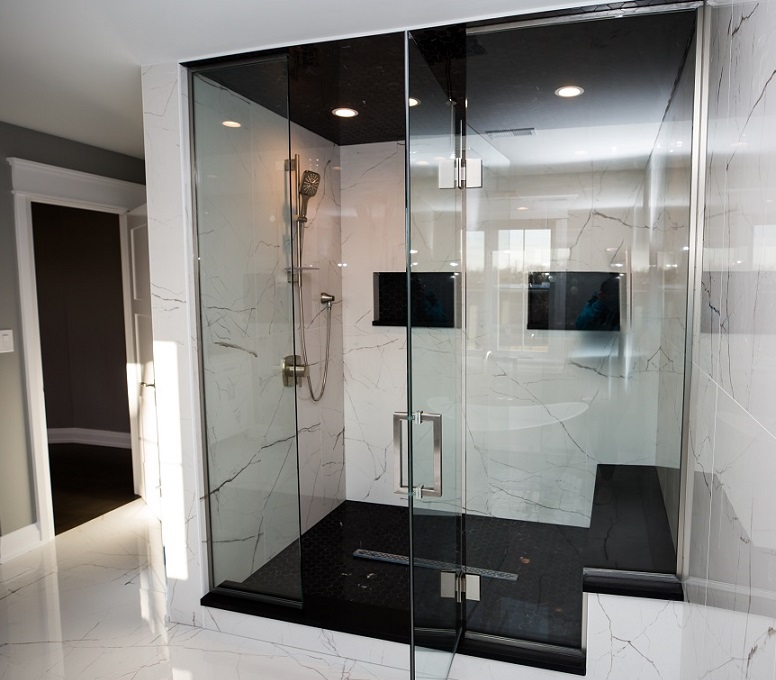
This same system is what makes features like curbless showers, built-in niches, and linear drains possible without extra risk. Each of those design choices adds seams, transitions, or slopes that need to be waterproofed correctly, and a continuous bonded membrane handles them the same way it handles a flat wall. If you're planning any of those upgrades, ask how your contractor's waterproofing approach accounts for them specifically — it's not a detail to leave to chance.
We've been called into homes in Barrington and Lake Zurich to fix showers that looked fine on the surface but had been leaking behind the tile for years. The signs are usually subtle at first: a soft spot on the floor outside the shower, grout that keeps cracking no matter how many times it's redone, or a faint musty smell that never quite goes away. By the time it's visible, you're often looking at replacing subfloor, wall framing, or even addressing mold — work that costs far more than the waterproofing would have in the first place.
None of those signs show up right away. That's the frustrating part for homeowners — a poorly waterproofed shower can look perfect for a year or two before anything seems wrong. By the time you notice a soft spot or smell mildew, water has usually been getting in for a while already, which is why the waterproofing step matters more than almost anything else in the remodel, even though it's the one part nobody sees once the job is finished.
This is also where cheap remodel quotes tend to cut corners. Waterproofing is invisible once the job is finished, so it's easy for a contractor to skip steps or use lower-grade materials without you ever knowing — until the damage shows up years later. Repairing a shower that's failed behind the tile almost always costs more than doing the waterproofing right the first time, because the tile, backer board, and sometimes the subfloor all have to come out before anything can be rebuilt.
A membrane waterproofing system typically adds some cost to a shower remodel compared to the cheapest traditional methods — usually a modest percentage of the total project, not a dramatic jump. In the context of a full bathroom remodel, it's a small line item relative to what you'd spend tearing out and rebuilding a shower that failed. Homeowners in Crystal Lake and the surrounding suburbs who've been through a leak repair almost always tell us they wish they'd asked about waterproofing specifics the first time around, rather than finding out the hard way what was — or wasn't — behind their old tile.
Before you hire anyone for a shower remodel, ask directly what waterproofing system they use and whether it's included in the quote or treated as an upsell. A contractor who can't answer specifically, or who treats it as an afterthought, is telling you something about how the rest of the job will go. It's also fair to ask whether they'll show you the membrane before it's covered — most reputable contractors are happy to send a photo once it's installed and sealed, since it's the one part of the job you won't be able to see again.
At SenkusBuild, Schluter waterproofing is standard on every shower we build — it's not an add-on and it's not optional. That's part of why we back our work with a 2-year craftsmanship warranty: we're confident in what's behind the tile, not just what you can see.
A shower is only as good as what's underneath it. If you're planning a remodel in Crystal Lake, Barrington, Lake Zurich, Cary, Algonquin, or the surrounding suburbs, we'll walk you through exactly how we waterproof, tile, and finish your space — no guesswork, no shortcuts. We'll also answer any questions you have about materials, timeline, or design before you commit to anything, so you know exactly what you're getting and why it's built to last.
Get a free estimate by calling (312) 684-8469 or visiting senkusbuild.com.