
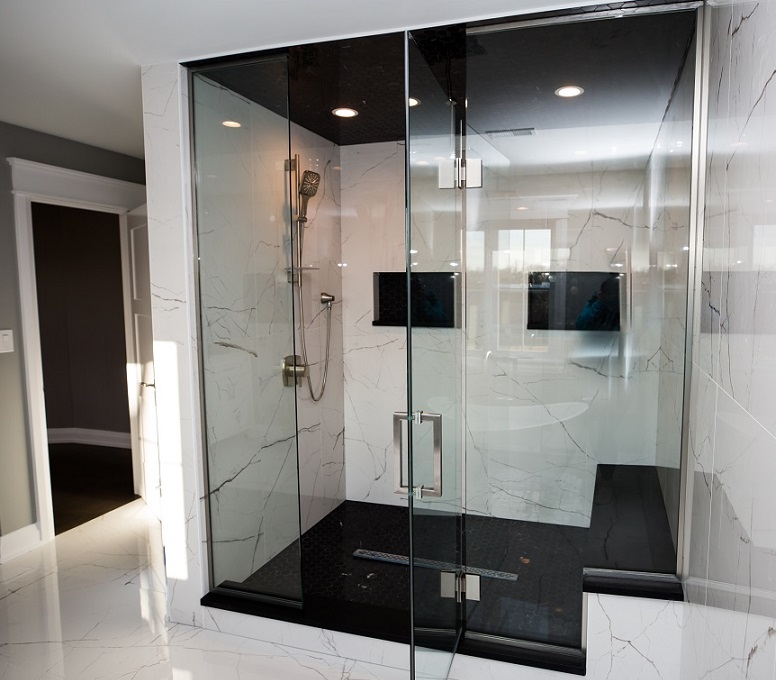
What Is the Schluter KERDI System? A Homeowner's Guide
Learn more

If you're remodeling a bathroom in Crystal Lake, Barrington, or anywhere in the northwest suburbs, you'll hear a lot about tile, glass, and fixtures. You'll hear much less about what goes behind the tile, and that's the part that decides whether your shower lasts. This is the Schluter KERDI system explained in plain English: what it is, how it works, and what to ask any contractor who quotes your shower.
KERDI is a waterproofing membrane made by Schluter Systems. It's a thin, flexible orange sheet that gets bonded to the walls and floor of your shower before any tile goes up. Think of it as a waterproof liner for the whole shower, with the tile sitting on top as the finish you see.
The important idea is that tile and grout are not waterproof. Water gets through grout lines and hairline cracks over time. The membrane underneath is what keeps that water from reaching your walls and subfloor. If you want the bigger picture on why this matters, we covered it in our guide to Schluter waterproofing for showers.
A KERDI shower is built as a connected set of parts rather than one product. Here's the basic sequence:
The point of the whole system is that the waterproofing is continuous. Every seam, corner, and drain connection is handled with a part designed for it.
There's more than one way to waterproof a shower, and a skilled installer can do older methods well. But the KERDI approach has a few advantages you can actually feel as a homeowner:
It's also not a magic fix. The membrane only works if it's installed correctly, which is why who does the work matters as much as the product.
One more practical note: because the membrane is bonded to the surface, it works best when the walls and floor underneath are flat, solid, and dry. That's why a good remodel includes checking the framing and subfloor first. Waterproofing over a soft or uneven surface just hides a problem instead of solving it.
Plenty of quotes say "waterproofed shower" without saying how. Here are questions that cut through it:
A contractor who answers these clearly, without getting vague, is usually one who takes this step seriously. A vague answer on the one part you'll never see again is worth noticing.
A lot of homes around Crystal Lake and Barrington have older bathrooms with out-of-square walls, settled floors, and surprises behind the tile. That's where a well-built membrane system earns its keep. We often find that the original shower in these homes was waterproofed with methods that have since failed, and the tile looked fine right up until the day it didn't. Rebuilding on a proper system means the new shower doesn't depend on the old structure to keep water out.
Waterproofing is the part of a shower nobody sees once the job is done, which makes it the easiest place to cut corners. We don't. SenkusBuild has completed 100+ bathroom remodels since 2019, and every custom tile shower we build starts with the layer you'll never look at again. It's backed by our 2-year craftsmanship warranty, and we walk you through the details during your estimate so you know what's going behind your walls before we start.
That's the Schluter KERDI system explained from a homeowner's point of view. The short version: pick a contractor who can explain exactly how your shower will be waterproofed, and who's happy to be asked.
If you're planning a bathroom remodel in Crystal Lake, Barrington, Lake Zurich, Cary, Algonquin, or nearby, we'll look at your space, talk through your options, and give you a clear estimate with no pressure.
Get a free estimate: call (312) 684-8469 or visit senkusbuild.com.